Chat made AI accessible because it borrowed the most familiar interface we had. But familiarity is not the same as fit. We used chat because it was the fastest way to bring people into the loop. Now that agents are starting to do more than answer questions, the loop itself has to change.
AI agents need more than a chat box.
That is the interface shift I think we are about to run into. Chat was a good bridge into AI, but it should not become the permanent container for agent work. It is starting to feel like fitting a square peg into a round hole: useful enough to prove the idea, awkward once the work gets serious.
A chatbot answers. An agent acts. It can run tasks, call tools, and come back when it needs a decision. Those three things alone change the shape of the product.
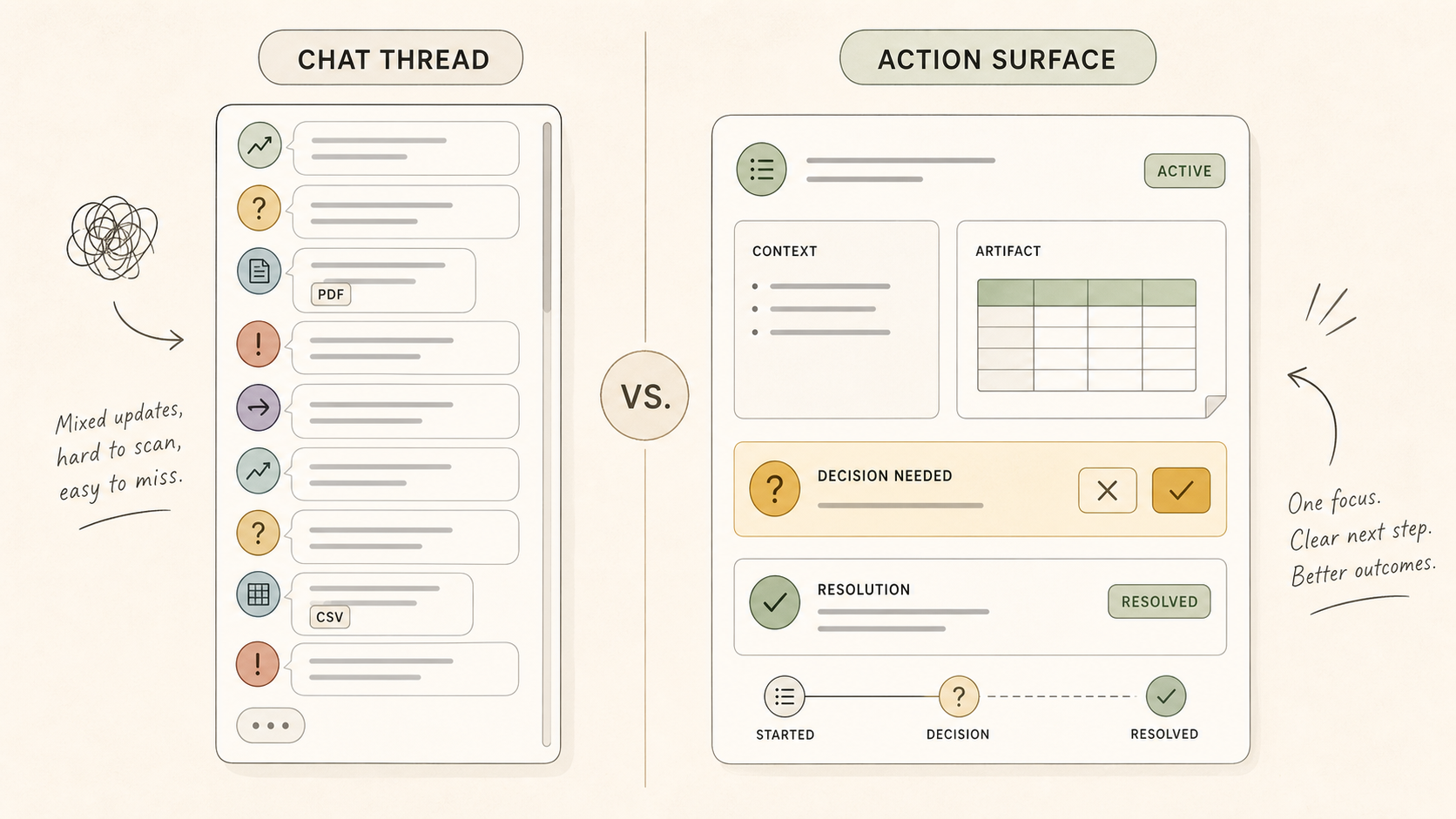
When the AI is only responding, a conversation makes sense. When the AI is working over time, a conversation becomes a bad place to manage state. Everything turns into another message: progress, approvals, failures, files, decisions, follow-ups. The user has to reconstruct what is happening from scrollback.
That is not the future interface. That is the old interface stretched too far.
As confidence builds in an agent’s ability, the less I want to watch it think out loud. I do not want a stream of updates proving that it is busy. I want it to keep moving inside clear boundaries and interrupt me when my judgment changes the outcome.
The better interface is not one that makes me feel like I am texting an assistant all day. It is one that surfaces the actions the agent should not take on its own.
This is where chat starts to break down. Chat treats a question, a status update, an approval request, and a finished artifact as basically the same thing. They all become messages. But in agent work, those are different objects. They have different urgency, different risk, and different endings.
An approval should not feel like another line in a thread. It should have context, consequence, and a clear button to say yes or no.
An exception should not be buried under status chatter. It should be surfaced because something changed and the agent needs human judgment.
An artifact should not be just another attachment drifting through scrollback. It should be tied to the action it supports and the decision it helped make.
That is a different paradigm from chat. The unit of interaction is not the message. It is the action.
An action has context. It has state. It has artifacts when artifacts help. It has a clear ask. It has a resolution.
A message disappears into history. An action can be completed.
I do not think this means chat goes away. There are still moments where open-ended conversation is exactly right: brainstorming, exploring a messy idea, refining a draft, talking through a decision. But that should be one mode, not the default container for everything an agent does.
The best agent interface may be the one that stays quiet until human judgment is needed.
That is where I think we are headed. Not toward agents that talk more like people, but toward agents that require less talking in the first place.
The point is not to keep the human constantly informed. It is to bring the human in at the moments where decisions matter most.